AI can already generate a surprising amount of code.
That is no longer the hardest part of software creation.
The harder part is turning generated work into software that is complete enough to run, reliable enough to trust, and structured enough to deliver.
That is the gap Teamo Code is built to close.
Teamo Code is a proactive coding agent for software delivery
The simplest way to understand Teamo Code is this:
Teamo Code is a goal runtime for software delivery.
Instead of treating software creation as a sequence of isolated prompts, Teamo Code is built to work from a target outcome.
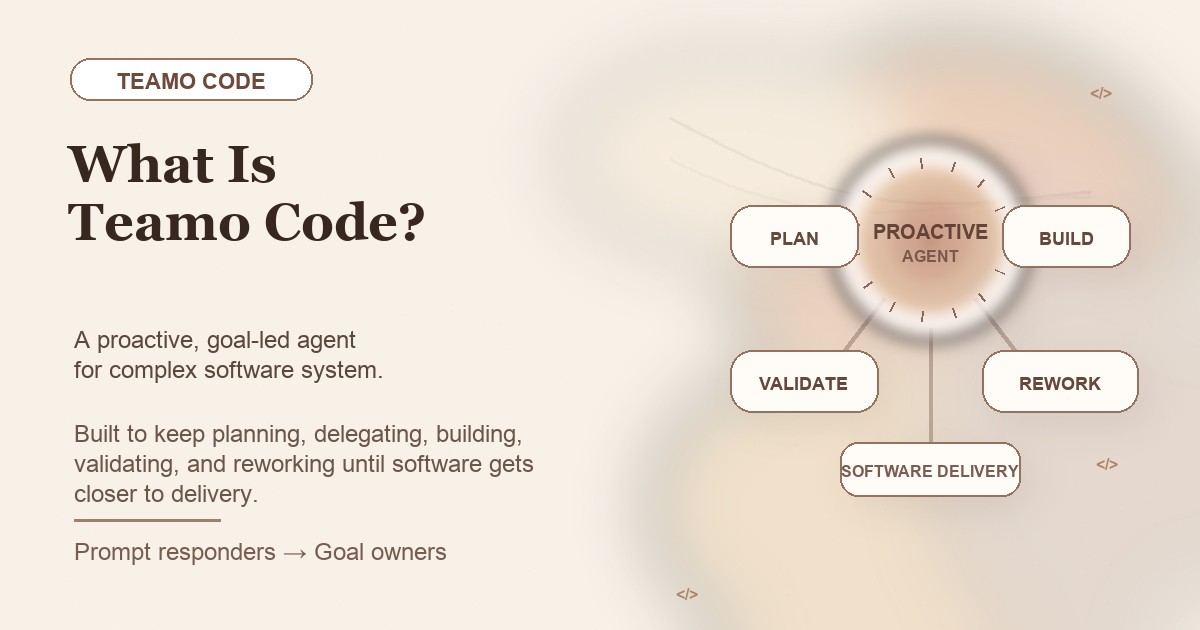
You define the goal. The system keeps planning, delegating, building, validating, and reworking until the software gets closer to a deliverable result.
That makes it fundamentally different from a traditional coding assistant.
Most coding tools are built to respond to the next prompt. Teamo Code is built to keep driving toward the final outcome.
From prompt responders to goal owners
This is the product shift that matters.
Over the last few years, AI coding tools have moved through clear stages:
- Autocomplete helped developers write the next piece of code faster.
- Interactive coding agents helped developers complete scoped tasks by editing files, running commands, and responding to prompts.
- Goal runtimes are the next step: systems built to keep advancing software toward delivery across longer execution cycles.
That is where Teamo Code fits.
Teamo Code is designed to turn coding agents from prompt responders into goal owners.
That means the value is no longer just “can it generate code?”
The value becomes:
- can it keep software moving?
- can it reduce the amount of delivery work that falls back to the human team?
- can it push through the messy middle between an idea and a usable system?
Why Teamo Code exists
The Cursor era changed expectations.
Teams now know AI can help build software faster. Developers can move more quickly. Founders can prototype faster. Product teams can test ideas with less engineering effort.
But once the software becomes serious, the old problem returns.
A system may generate an impressive first pass, but that does not mean it is ready to use.
Humans still end up carrying the hardest parts of delivery:
- breaking the project into moving parts
- figuring out what is incomplete
- catching what fails in real usage
- coordinating the next round of work
- deciding when the software is finally ready
This is why the real bottleneck is no longer code generation.
It is software delivery certainty.
Teamo Code is built around that problem.
What makes Teamo Code different?
Most coding agents are optimized for task completion.
Teamo Code is optimized for sustained system delivery.
A task agent can still be very capable. It can implement a feature, fix a bug, refactor a module, or complete a scoped engineering request.
But after that burst of work, the delivery burden often returns to the human.
Teamo Code is built for the stage after that.
Its job is not simply to produce another answer. Its job is to keep reducing the gap between the current system and the intended system.
That means continuity across execution cycles, coordination across workstreams, validation beyond code generation, and repair loops that keep the project moving forward.
What can Teamo Code build?
To test whether this model is real, Teamo Code is pushed against software goals that reveal whether a system can carry complexity over time.
Examples include:
Recreate Claude Code
A coding product with a real agent experience, not just a static interface.
Enterprise ERP
A multi-module business system spanning customers, inventory, orders, and finance.
Strategy Game
A browser-based game with interacting mechanics, state, balancing logic, and player-facing complexity.
iOS Health App
A mobile product with records, reminders, vitals, and structured user workflows.
These examples matter because they force a higher standard than “can it make a page?”
They require coordination, product logic, continuity, and validation — the things that usually determine whether software actually becomes usable.
The real question is whether AI can reduce the uncertainty of delivery.
FAQ
How is Teamo Code different from a coding assistant?
A coding assistant helps generate code, answer prompts, and complete scoped tasks. Teamo Code is built for the stage after that: planning, coordinating, validating, repairing, and continuing until the software becomes more complete and more usable.
Is Teamo Code just another AI coding agent?
No. Most coding agents are optimized for task completion. Teamo Code is optimized for sustained system delivery by harnessing an agent team.
What kinds of software can Teamo Code build?
Teamo Code is built for software goals that require structure, continuity, and validation. Examples include coding products, enterprise ERP systems, strategy games, and mobile health apps.
How does Teamo Code reduce delivery uncertainty?
It works from the goal, decomposes the system, coordinates multiple agents, validates outputs, pushes through repair loops, and makes progress visible enough for teams to inspect and trust.
Related reading: