AI coding tools changed one thing for everyone: people now believe software can be created much faster than before.
But for serious companies, speed is no longer the hardest question.
The hardest question is certainty.
- Can this system actually get built?
- Can it become complete enough to run?
- Can it hold together across modules, workflows, and edge cases?
- Can a team trust it enough to put it in front of users, customers, or internal operations?
That is why we built Teamo Code.
Teamo Code is not another prompt-response coding assistant. It is a proactive, goal-led coding agent for complex software systems.
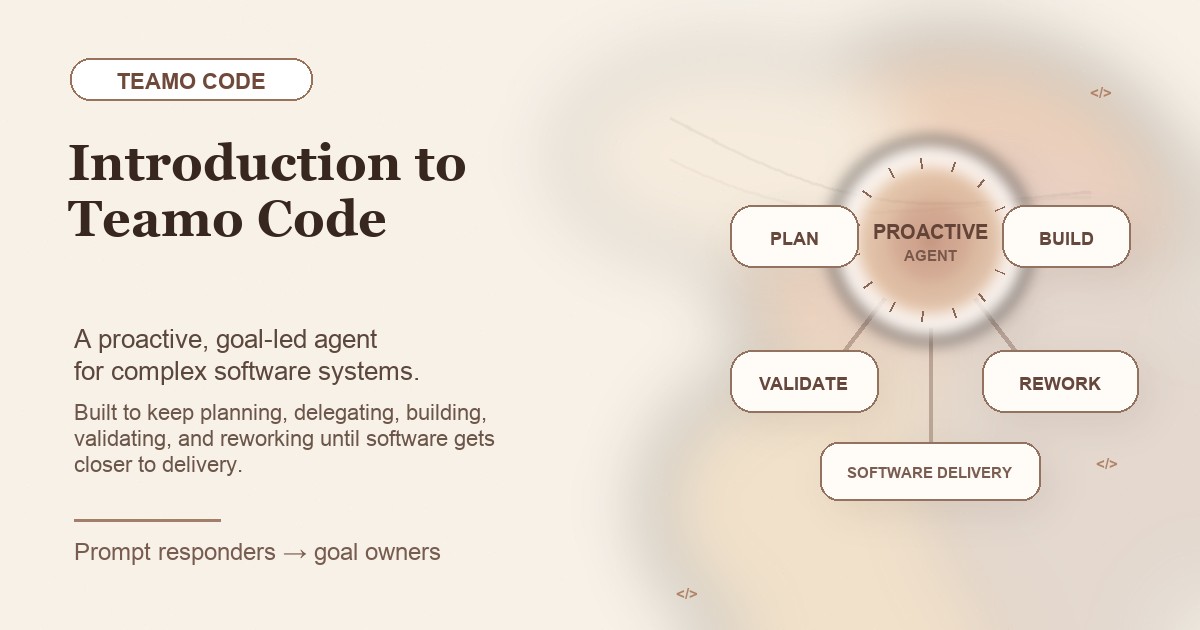
You define the outcome. Teamo keeps planning, delegating, building, validating, and reworking until the software reaches a deliverable state.
What is Teamo Code?
Teamo Code is a proactive, goal-led coding agent for complex software systems.
That means it is designed to work from a target outcome rather than a sequence of isolated prompts.
As we have been framing it internally:
Teamo turns coding agents from prompt responders into goal owners: you define the outcome, and it continuously orchestrates agents until the software is ready to deliver.
Put more simply:
Give it a goal, not a prompt.
Or, in another formulation:
Teamo is a goal runtime for software: it continuously plans, delegates, builds, and validates until the work is ready to deliver.
This is the defining shift in the product.
Most coding tools are still designed around responding to the next request. Teamo Code is built around reducing the gap between the current state of the system and the intended result.
Instead of stopping after the first generation pass, it is designed to keep advancing the project until the software becomes more coherent, more complete, and closer to something a team can actually ship and use.
What makes Teamo Code different?
The simplest way to understand Teamo Code is this:
Most coding agents are optimized for task completion. Teamo Code is optimized for sustained system delivery.
A task agent can still be extremely capable. It can implement a feature, fix a bug, refactor a module, update a workflow, or complete a scoped engineering request.
But after that work is done, the project usually falls back to the human.
The human still owns:
- what comes next
- what remains incomplete
- what broke when the software was actually used
- what still blocks delivery
- when to continue and when to stop
Teamo Code is built for the stage after that.
Its job is not merely to produce another output. Its job is to keep driving the system toward a deliverable state.
That means continuity across execution cycles, coordination across workstreams, validation beyond code generation, and repair loops that push the project forward instead of just exposing problems.
In other words, we are not asking only whether AI can write more code.
We are asking whether AI can take more responsibility for getting software done.
What Teamo Code is built to create
To test whether this model is real, we do not use only toy examples.
We push Teamo Code against software goals that reveal whether a system can carry complexity over time.
Examples include:
Recreate Claude Code
Generate a fully functional coding agent experience inspired by Claude Code.
Enterprise ERP
Generate a multi-module ERP with customers, inventory, orders, and finance.
Strategy Game
Generate a browser-based city-building strategy game with tech trees, events, and trading.
iOS Health App
Generate a mobile health management app with medications, vitals, and family profiles.
These examples matter because they force a higher standard than “can it make a page?”
They force the system to deal with coordination, product logic, validation, structure, and continuity.
That is where we believe the future of AI software will be decided.
Not by who can generate the most code in one pass, but by who can keep a software system moving until it starts to hold together as something real.
How Teamo builds complex software
1. Goal-led execution, not prompt-by-prompt work
A leader agent continuously tracks what stands between the project and a shippable outcome. It proactively breaks work down, delegates coding tasks, fixes bugs and system issues, and only raises async issues when human input is actually needed. As requirements change, it updates the plan and keeps the project moving.
2. A persistent multi-agent team for complex systems
For complex software, Teamo automatically organizes a team of specialized agents across business and technical modules. Each agent owns a relatively decoupled part of the system and keeps persistent context, so work remains iterative, traceable, and ready to resume at any time.
3. Verified delivery with full visibility
Each module-level coding agent is paired with reviewer agents that examine work across functionality, performance, security, and other quality dimensions.
Before delivery, the leader agent drives cross-module integration, smoke testing, and end-to-end validation, while surfacing team activity, issues, task breakdowns, progress, and final acceptance reports.
From generated code to delivered software
For serious software teams, the biggest risk is no longer that AI cannot generate enough code. It is that your organization starts producing more software without increasing delivery certainty.
More output, more complexity, more hidden failures — but no system that actually owns the outcome. At team scale, that does not create leverage. It creates execution risk.
We built Teamo Code to change that: not by generating more work, but by giving teams a runtime that keeps driving software toward a deliverable result.
Join the waitlist: https://teamocode.com/
FAQ
What is Teamo Code?
Teamo Code is a proactive, goal-led coding agent designed for complex software systems. Instead of stopping after a single prompt or code generation pass, it keeps planning, delegating, building, validating, and reworking until the software is closer to a deliverable state.
What does proactive mean?
In Teamo Code, proactive means the system does not wait for the user to specify every next step. Once you define the goal, it can identify what remains incomplete, break work into tasks, coordinate agents across planning, execution, and review, and keep pushing the software toward delivery until human input is actually needed.
How is Teamo Code different from other AI coding agents?
Most AI coding agents are designed to respond to the next request—generate a function, fix a bug, or refactor a file. Teamo Code is built on a state-of-the-art harness architecture that orchestrates an agent team across planning, execution, and review, continuously driving the system toward a more complete and deliverable state.
Who should use Teamo Code?
Teamo Code is best suited for teams, builders, and operators working on serious software projects where reliability, continuity, and delivery matter. If your main problem is no longer writing code, but getting complex software to actually hold together and ship, Teamo Code is built for that stage.
Related reading: