Claude Code and Codex changed what people expect from AI coding.
They proved that an AI system can do much more than autocomplete. It can inspect a codebase, edit files, run commands, solve scoped tasks, and produce meaningful engineering work from a prompt.
That was a major shift.
But it still leaves one big limitation in place: the human remains responsible for driving the process.
You still have to decide what comes next. You still have to notice what is incomplete. You still have to spot what breaks when the software meets real workflows. You still have to push the next round of fixes, coordinate the next round of work, and carry the project toward delivery.
In other words, these systems are powerful task agents.
But they are not yet proactive, autonomous software delivery systems.
That is the gap Teamo Code is built to close.
From prompt responders to proactive goal owners
Teamo Code is not trying to replace Claude Code or Codex.
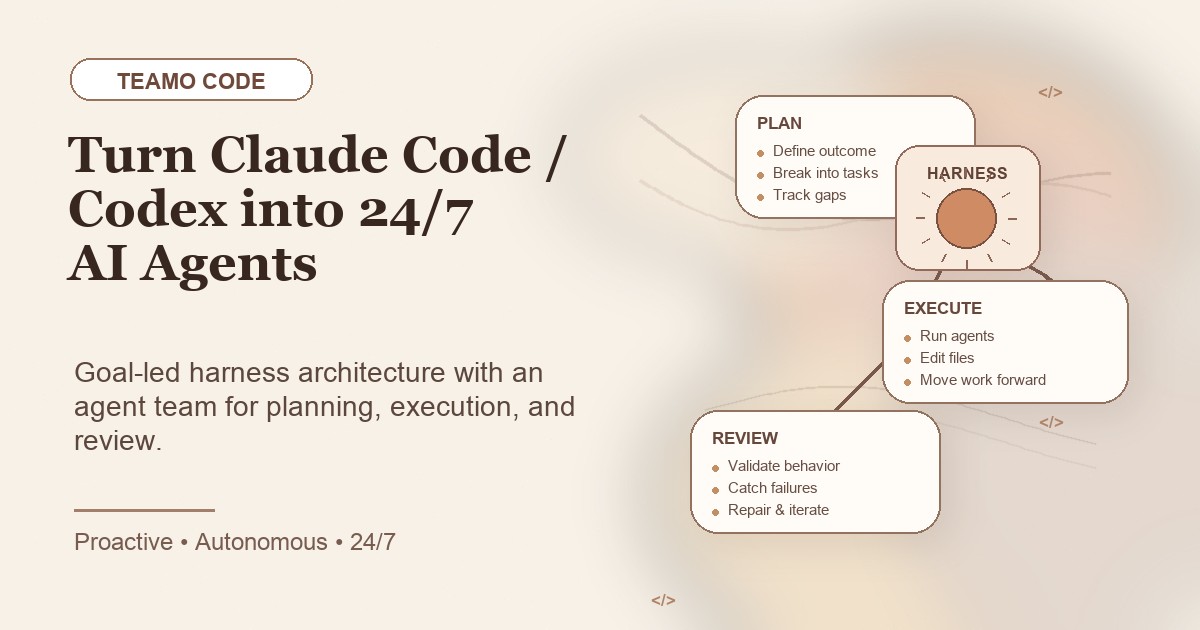
It is built to turn systems like them into something more powerful: proactive, autonomous agents that keep pushing software toward a real outcome.
The difference sounds small at first, but it changes everything.
- A task agent waits for the next instruction. A proactive system keeps moving.
- A task agent can finish what you ask for. A goal-driven system keeps working toward what you actually want.
- A task agent is valuable at the level of execution. A proactive delivery system becomes valuable at the level of outcome.
That is why Teamo Code is best understood as a goal runtime for software delivery.
You define the outcome. Teamo keeps planning, delegating, building, validating, and repairing until the software gets closer to a deliverable result.
Why this matters
AI already made code generation cheap.
But serious software is still expensive to deliver.
That is because delivery is not just code production.
Delivery means:
- carrying a system across multiple modules and workflows
- preserving coherence as the software evolves
- validating behavior under real usage conditions
- catching and fixing failures that show up only after the first pass
- deciding when the system is finally good enough to use
This is where most teams still fall back to manual coordination.
The first pass may be faster than ever.
The messy middle is not.
And the messy middle is where real products live.
That is why the next step in AI coding is not simply “better generation.”
It is proactive execution toward a goal.
What Teamo Code adds on top of today’s coding agents
Teamo Code is built around a different model from standard prompt-response workflows.
1. Goal-led execution
Instead of optimizing around the next request, Teamo Code works from the target outcome.
That means the system keeps tracking what stands between the current project and the intended software state, rather than waiting for a human to keep manually restarting the loop.
2. Persistent multi-agent coordination
Complex software does not get built well by one flat stream of execution.
Teamo Code organizes specialized agents around different parts of the system so progress can continue across multiple workstreams while still moving toward one shared result.
3. Validation and repair loops
A proactive system cannot stop at generation.
It has to validate what was built, identify where the system fails, push through fixes, and continue advancing toward delivery.
4. Longer-running autonomy
A useful AI coding system should not become idle the moment the first task is done.
Teamo Code is designed for longer execution cycles, where the system can keep progressing until a meaningful checkpoint or decision point is reached.
That is what makes it feel less like a coding assistant and more like an autonomous delivery layer.
What this looks like in practice
The easiest way to understand Teamo Code is through the kinds of software goals it is designed to carry.
Examples include:
Recreate Claude Code
Not just a visual clone, but a real coding product with an agent experience.
Enterprise ERP
A multi-module business system spanning customers, inventory, orders, and finance.
Strategy Game
A system with interacting mechanics, state, balancing, and real internal complexity.
iOS Health App
A structured mobile product with records, reminders, vitals, and user workflows.
The real shift is from task completion to continuous progression
This is the larger point behind Teamo Code.
The last wave of AI coding has already shown that task agents work: they can generate code, fix scoped bugs, refactor files, and complete well-defined engineering requests with impressive speed.
But the next wave will not be defined by how well AI responds to the next prompt. It will be defined by whether these agents can become proactive, longer-running, goal-driven systems that keep moving software forward after the first task is complete.
That is the real shift.
A task agent responds to an instruction, completes the work, and stops. A goal-driven system continues. It continues through decomposition, execution, validation, and repair, reducing the distance between the current state of the project and the intended outcome.
In serious software delivery, that continuity matters more than any single generation pass, because real products are shaped not only by what gets built first, but by how reliably the system keeps progressing through the messy middle.
Why Teamo Code matters now
For developers, the immediate benefit of AI coding has been speed. For founders, CEOs, and CTOs, the more important question is certainty.
They do not only want code to be generated faster; they want software to move toward delivery with less coordination overhead and less execution risk.
That is exactly why turning Claude Code or Codex into proactive, autonomous 24/7 AI agents matters.
The opportunity is not to add more novelty to AI coding, but to take systems that are already powerful and evolve them into a new category: goal-driven software delivery systems.
That is the category Teamo Code is built for.
FAQ
What does it mean to turn Claude Code or Codex into proactive, autonomous 24/7 AI agents?
It means moving beyond prompt-by-prompt task execution. Instead of waiting for a human to provide every next instruction, a proactive system can keep planning, executing, validating, and repairing work in pursuit of a broader software goal. The shift is from completing isolated tasks to continuously driving a project toward delivery.
How is Teamo Code different from Claude Code or Codex?
Claude Code and Codex are powerful coding agents for scoped execution: they can inspect code, make changes, run commands, and complete well-defined tasks. Teamo Code is built as a goal runtime on top of that model. It is designed to help those systems operate more proactively over longer execution cycles, with stronger continuity, coordination, and progress toward a deliverable outcome.
What does proactive mean in AI coding?
Proactive means the system does not stop after the first generation pass or wait for the next manual prompt. Once a goal is defined, it can identify what remains incomplete, break work into tasks, coordinate execution, review outputs, and continue pushing the software forward until human input is actually needed.
Can Teamo Code help with validation and repair, not just code generation?
Yes. A core part of the Teamo Code approach is that progress does not stop at generation. The system is designed to include validation, identify failures, coordinate fixes, and keep moving the project toward a more complete and usable state.
Related reading: